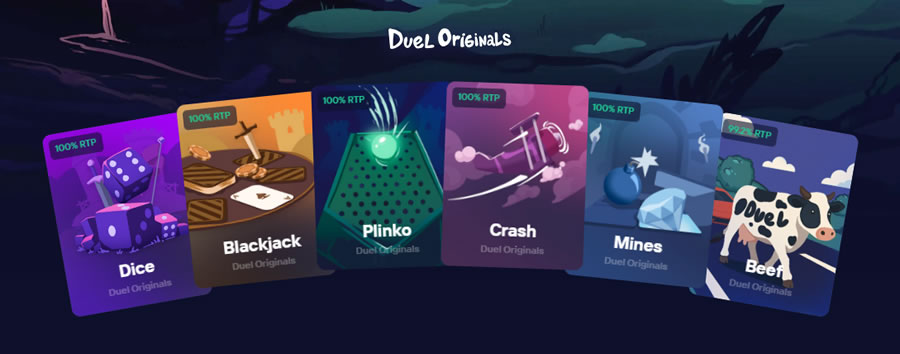
Duel Originals Beef is a high volatility path game on Duel Casino where you guide a cow across a dangerous road. Each safe step forward increases your multiplier, but one wrong move into a trap ends the run and destroys your stake. The game offers four difficulty levels and a provably fair system, combining simple rules with very sharp swings.
This guide explains how Duel Beef works, how the Easy, Medium, Hard and Extreme difficulty levels change risk, how multipliers and RTP interact, and how to build safer paths and bankroll plans. Even though Beef is designed with a high RTP, it is still a casino game with serious variance. You should treat every run as paid entertainment, not as a reliable way to grow money.
The core idea of Duel Beef is simple: you place a bet, choose a difficulty level and then help a cartoon cow cross a series of road lanes. At each lane you select where the cow will step. If the step is safe, your multiplier increases and you can continue or cash out. If the cow lands on a trap, the run ends immediately and you lose your entire bet for that round.
Instead of spinning reels or dropping balls, Beef turns your bet into a sequence of steps. The more successful steps you string together, the higher your potential payout. The tension comes from deciding when to stop and take your winnings before the next lane hides a trap.
Visually, Duel Beef presents a straight road divided into consecutive lanes. In each lane there are several possible positions where your cow can move. You do not see where the traps are, only the available positions for the next step. When you pick a lane position, one of two things happens:
The number of safe positions and traps in each lane depends on the difficulty level. Easier modes provide more safe options per lane, while harder modes reduce the number of safe paths and make each step more dangerous but more rewarding when you succeed.
Like other Duel Originals, Beef uses a provably fair system to generate outcomes. Before any runs are played, the server creates a secret server seed, and your browser or app provides a client seed. Together with a nonce that increments for each run, these values feed a cryptographic function that determines where traps and safe tiles appear along your cow's path.
After the server seed is revealed, you can use the server seed, your client seed and the nonces to verify that the sequence of safe steps and traps for each run matches what you saw during play. This proves that the game did not adjust results after seeing your bet size. You cannot predict the next run from the previous ones, but you can verify that past runs were generated honestly.
Easy difficulty is designed as a gentle introduction to Duel Beef. On Easy, each lane contains relatively more safe positions compared to traps. This means that your cow has a higher chance of surviving each step, and you are more likely to experience several successful moves in a row.
The tradeoff is that multipliers grow more slowly on Easy than on harder levels. Each safe step bumps your multiplier up, but not dramatically. Easy is a good mode for learning how the game feels, experimenting with different cashout points and running longer sessions with smaller swings, as long as your stakes remain modest.
Medium difficulty moves Duel Beef into a more intense zone. The proportion of safe positions to traps becomes less forgiving, and busts arrive more frequently than on Easy. In return, each safe step typically adds more to your multiplier, making individual runs feel more impactful.
Medium suits players who understand that Beef is a high variance game and who are comfortable with sessions that can swing up or down quickly. You still have enough safe options per lane to build multi step runs occasionally, but you must accept that many runs will end earlier than you hope, even with cautious choices.
Hard and Extreme difficulties are where Duel Beef becomes truly dangerous. Safe positions in each lane are scarce, traps are common and multipliers grow quickly with every successful step. In these modes, deep runs can produce very large multipliers, but most attempts will end after only a few lanes or even at the very beginning.
On Hard and especially on Extreme, the combination of fast multiplier growth and low survival chance creates extreme volatility. A small number of lucky runs produce impressive screenshots, but many more runs quietly eat through stakes. These modes are appropriate only for tiny stakes and for players who consciously seek high risk entertainment, not for anyone trying to recover losses.
| Difficulty level | Safe lane density (feeling) | Multiplier growth per safe step | Volatility | Recommended stake size |
|---|---|---|---|---|
| Easy | Many safe lanes | Slow and steady | Low to medium | Small, but not minimum |
| Medium | Balanced safe vs traps | Moderate | Medium to high | Small, cautious |
| Hard | Few safe lanes | Fast | High | Tiny stakes |
| Extreme | Very few safe lanes | Very fast | Extreme | Tiny stakes only |
Duel Beef is often described as a high RTP game, with return to player reported in the 99 percent range when averaged over a huge number of runs. In practical terms, this means that for every 100 units wagered by all players together, around 99 units are expected to be paid back over the very long term, leaving a small house edge.
This small edge does not make Beef safe. Because the game is highly volatile, actual results for an individual player over weeks or months can be far above or far below the theoretical average. A few deep wins can create big temporary profits, while long sequences of short runs can produce significant losses even though the formal RTP looks attractive.
In Duel Beef, multipliers grow with each safe step your cow takes. Early steps may increase the multiplier modestly, but as you progress further down the road, the growth can speed up, especially on Hard and Extreme. The deeper you go, the more your potential payout diverges from your starting stake.
The game is designed so that in rare cases, long flawless runs can lead to very large multipliers. These extremes are mathematically possible but occur infrequently and are balanced by the large number of runs that end much earlier. When you look at examples of huge wins, remember that they represent the far end of a probability curve, not a typical outcome you should expect to repeat.
Depending on the current Duel Casino policy, Beef runs may contribute to rakeback or similar reward systems. When they do, a portion of the theoretical house edge is returned to you over time as bonuses tied to your betting volume. This slightly reduces your long term cost for playing Beef, especially if you choose lower difficulties and small stakes.
However, rakeback does not cancel high variance. To earn meaningful rewards you must place a large number of bets, which increases your exposure to swings. Rakeback should be seen as partial compensation for the entertainment cost, not as a guarantee that you will break even or profit from Beef sessions.
Each Duel Beef round starts with three main choices:
A sensible approach is to begin on Easy or Medium with very small stakes until you fully understand how quickly runs can end and how your emotions react to wins and losses. Hard and Extreme should be treated as optional modes for later, and only for stake sizes that you are entirely comfortable losing in a few seconds.
Once a run begins, you will see the next lane with several positions where your cow can move. You choose one of these positions as the next step. The interface clearly shows available options, and after your choice the game immediately reveals whether the step was safe or a trap.
If the step is safe, the multiplier increases and the cow moves forward. You then face the same decision again on the next lane: select a new position or cash out. The challenge is that the board gives you no reliable hints about where traps are. Past runs and apparent patterns in where you have previously seen traps do not change the actual odds for the current lane.
After every successful step, Duel Beef displays your current multiplier and potential payout if you cash out now. You are free to end the run at any time between steps. If you click the cashout button, your run ends and you receive your stake multiplied by the current multiplier.
If you decide to keep going, you expose your entire stake and accumulated winnings to the risk of the next step. There is no warning before a trap; the only control you have is over how long you stay in the run. The longer you walk the cow down the road, the higher your potential payout, but the more you risk turning that payout back into zero.
Low risk Beef strategies focus on Easy difficulty and early cashouts. The goal is not to chase massive multipliers, but to experience many small or moderate wins and to keep variance as manageable as possible for such a volatile game.
This style will still generate losing runs where you step on a trap immediately, but it reduces the frequency of deep, painful busts compared to higher difficulties. Even so, long sequences of early traps can happen and should be expected over time. Low risk does not mean no risk.
Balanced strategies use Medium difficulty and pre planned exit points. You accept more variance than on Easy in exchange for stronger multiplier growth per safe step. To avoid getting lost in emotional decisions, it helps to define specific step targets and stick to them.
This approach can create sessions where some runs hit satisfying multipliers and others end quickly. The key is to prevent your plan from shifting mid session toward always chasing one more step, which is where many players lose the benefit of having a structure in the first place.
High risk Beef strategies are built around Hard and Extreme difficulties, but only with tiny stakes. Here you rely on the rare possibility of deep runs that generate very large multipliers, fully aware that most runs will crash early.
If you ever start increasing stake sizes on Hard or Extreme because you are frustrated or convinced that a big run must be coming soon, it is a strong signal to stop playing. High risk Beef is most dangerous when you use it to chase losses or to satisfy impatience.
Effective Beef bankroll management starts with clear boundaries. Instead of mixing all your funds and all games together, it can be useful to allocate a dedicated portion of your gambling bankroll to Duel Beef and then break that into smaller session budgets.
Within each session, choose a bet per run that is a small fraction of your total bankroll. On Easy and Medium difficulties, this might be around 0.5 to 1 percent of your overall bankroll. On Hard and Extreme, it should often be even smaller, because busts can come rapidly.
| Total bankroll | Beef session slice | Difficulty | Bet per run | Steps target | Session stop-loss |
|---|---|---|---|---|---|
| 50 units | 10 units | Easy | 0.25 units | 1 - 2 steps | Full 10 units |
| 100 units | 20 units | Medium | 0.5 units | 2 - 3 steps | 10 - 20 units |
| 200 units | 40 units | Hard | 0.4 units | 1 - 2 steps | 20 - 40 units |
Because Beef can produce fast, dramatic swings, it is important to define when you will stop playing before you begin a session. Stop-loss and stop-win rules help you avoid extending a session until your entire Beef bankroll is gone or until tilt takes over.
Combining all three gives you multiple ways to close a session in a controlled fashion. If any one of them is hit, you stop playing Beef for the day. This protects both your bankroll and your mental state.
One of the most dangerous patterns in high volatility games is using them to chase losses from other games. It can be tempting to think that a single big Beef run will erase deficits from Dice, Crash or other Duel Originals. In reality, Beef is designed with sharp variance, which makes it unsuitable as a tool for recovery.
If you are already down from previous sessions or other games, it is safer to step back and reassess your overall gambling instead of jumping into Beef with the hope of a quick fix. Beef works best when it is treated as a separate entertainment module with its own small budget, not as a last resort to break even.
Duel Beef and Duel Crash share a focus on high multipliers and fast outcomes, but they deliver that experience differently. Crash uses a single multiplier line that rises until it suddenly crashes. Players across the table share the same multiplier and must decide when to jump out before the bust.
Beef, by contrast, gives you a personal path across a road. You make discrete step decisions in each lane, and your multiplier changes in steps rather than along a continuous line. Some players find Crash more stressful because they depend on timing and reading a shared graph, while Beef feels more like a series of small path choices with a similar risk profile.
Compared to Duel Mines, Beef restricts your movement to a forward road instead of a full grid. In Mines, you choose tiles anywhere on a two dimensional board, with mine count controlling volatility. In Beef, you move from lane to lane in a straight path, choosing one of several positions on each row.
Both games are tile based and high risk, but they feel different. Mines offers more freedom in where you click and often a slightly more puzzle like experience. Beef keeps you on a fixed highway, which can simplify decisions while keeping the emotional impact of each step high.
For some players, the volatility of Beef is simply too intense. If you prefer games where you can see and control probabilities more clearly, or where skill plays a bigger role, other Duel Originals may be a better fit. Duel Dice lets you choose an exact win chance and payout, which can create more controlled, number based risk. Duel Blackjack focuses on structured decisions and basic strategy, offering a very low house edge when played well.
If you feel overwhelmed by Beef swings or tempted to overspend, it can be healthier to move toward these more controlled formats. You can read the Duel Dice article if you want to move from cow lanes to more controlled, number based sessions, or switch to disciplined card play in the Duel Blackjack guide if you prefer structured strategy over raw Beef volatility and see whether those games match your temperament better.
| Game | Volatility level | Decision density per round | Best for |
|---|---|---|---|
| Dice | Low to high (configurable) | Low to medium | Players who like clear probabilities and sliders |
| Blackjack | Low to medium | Medium to high | Players who enjoy structured strategy and low edge |
| Plinko | Low to very high (by settings) | Low | Visual drop fans and rakeback volume |
| Crash | High to extreme | Low to medium | Thrill seekers who accept fast swings |
| Mines | Medium to high | High | Players who like tile based puzzles |
| Beef | High to extreme | Medium | Players who want step based high risk runs |
Duel Beef is easy to play on a phone. The interface shows the lanes clearly, and you can select a path with simple taps. The cashout button is usually positioned within comfortable thumb reach, and the minimalistic visual style keeps the focus on the cow and the next step rather than on distractions.
Mobile convenience, however, makes it tempting to play many short runs while doing other things. If you treat Beef as a background activity while watching videos or commuting, you may not fully notice how quickly multiple small bets add up or how your mood shifts with rapid losses.
On mobile, two problems often appear together: autopilot and tilt. Autopilot means you start another run as soon as one ends, without pausing to think about your bankroll or your plan. Tilt means emotional reactions to losses, such as frustration or anger, that push you to keep playing despite your limits.
To reduce these risks:
Beef is most enjoyable when you play with full attention and treat each decision as deliberate, not when it becomes a reflex between notifications.
Duel Originals Beef can be a good fit if you genuinely enjoy high risk gambling formats and understand what that implies. It suits players who:
For such players, Beef offers a distinctive, step based way to experience variance, with clear control over difficulty level and run length, but without illusions about guaranteed profit.
Beef may be a poor choice if:
If any of these points sound familiar, it may be safer to focus on lower volatility games like Dice or Blackjack, or to take a break from gambling altogether. No level of strategy or self talk can make Beef risk free.
Duel Beef lets you bet on a cow crossing a road filled with hidden traps. You pick a difficulty, place a bet and then choose lanes for each step forward. Every safe step increases your multiplier and potential payout, but if you step on a trap before cashing out, you lose the entire stake for that run. The game ends either when you cash out or when your cow hits a trap.
Beef has four difficulties: Easy, Medium, Hard and Extreme. Easy offers more safe lanes and slower multiplier growth, making runs feel smoother. Medium balances safe lanes and traps with stronger multipliers. Hard and Extreme sharply reduce safe options while increasing multiplier growth, creating much more volatile runs that are only suitable for very small stakes.
Beef is generally presented as a high RTP game, meaning that a large portion of the total amount wagered by all players is expected to be returned as winnings over the long term. However, RTP is a long term theoretical measure, not a promise for individual sessions or players. Because Beef is highly volatile, some players will see big wins, others will see heavy losses, and both experiences are compatible with the same advertised RTP.
Extreme difficulty is much riskier than Easy. On Extreme, safe lanes are scarce and traps are common, so many runs will end very early. The upside is that each safe step adds more to your multiplier than on Easy, but this extra reward comes at the cost of a much lower survival rate. For most players, Extreme should be used only for occasional tiny stake runs, not as a regular way to play Beef.
A reasonable cashout plan aligns with your difficulty level, stake size and risk tolerance. On Easy, many players aim for one or two safe steps before cashing out. On Medium, two or three steps can make sense if stakes are small. On Hard and Extreme, it is often safer to accept very early exits, especially if you have already reached a meaningful multiplier. The key is to decide your targets before playing and to resist the impulse to always chase one more step.
Using Beef to recover losses from other games is usually a bad idea. Beef is designed with sharp variance, so you can easily lose additional money quickly while trying to chase a big win. Recovery thinking tends to push players into bigger stakes and riskier decisions, which amplifies losses instead of fixing them. If you are down from other games, it is safer to pause gambling entirely or reassess your overall limits rather than turn to Beef as a solution.
The mathematical risk of Beef is the same on mobile and desktop, but your behavior may differ between devices. On mobile, it is easier to play many short runs in distracting environments, which can increase autopilot and tilt. On desktop, you may be more likely to treat Beef as a focused session. The safer platform is the one where you can pay attention to your decisions, respect limits and avoid impulsive play.
There is no universal ideal length for a Beef session, but it should be defined by your own time and money limits rather than by how the game feels in the moment. Many players set a time limit, such as 20 to 40 minutes, combined with a strict stop-loss on their Beef session slice. Once either limit is hit, ending the session helps keep Beef in the realm of controlled entertainment instead of letting it expand into the rest of your day and bankroll.







© 2026 Duel Casino All rights reserved